
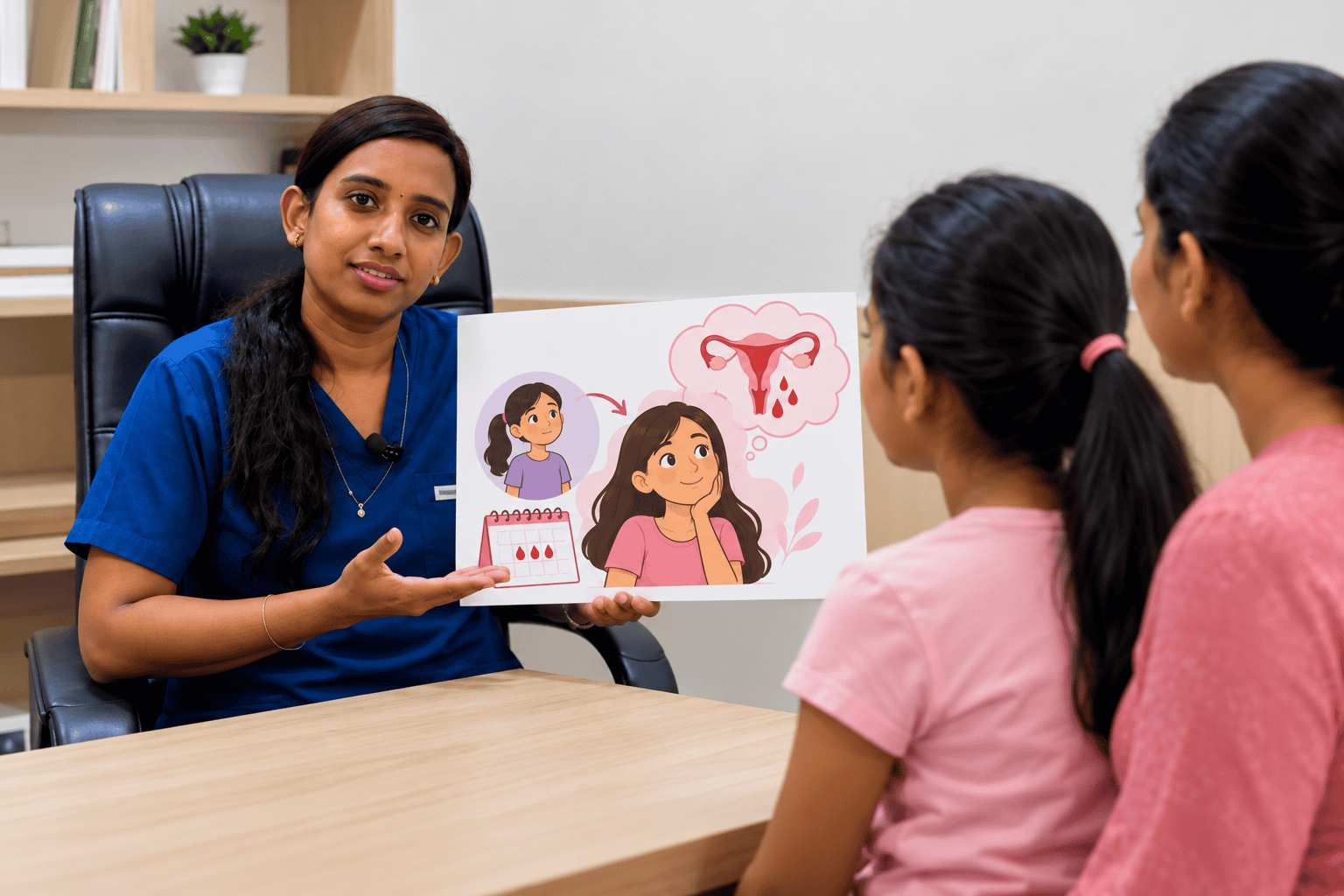
What Is the First Period Called?
A girl’s first menstrual period is called menarche.
A first period can bring a lot of questions for both children and parents. “Is this too early?” “Is something wrong?” “Does my daughter need to be evaluated?”
Periods are a normal part of puberty, but when menstrual bleeding appears unusually early, it is reasonable for parents to discuss the timing and other signs of puberty with a healthcare professional.
The important thing to remember is that the age at which a girl gets her first period is only one part of the picture. Doctors also look at when breast development and other signs of puberty began, how quickly they are progressing, the child’s growth pattern and other medical factors.
When Is Puberty Considered Too Early?
Precocious puberty is traditionally defined as the development of secondary sexual characteristics before age 8 in girls. Signs can include breast development, pubic or underarm hair, rapid growth and, later in the process, menstruation.
However, having a period at a younger-than-expected age does not automatically mean that a child has a medical disorder.
Doctors consider the entire pattern of development: when breast development began, whether growth has accelerated, whether other puberty changes are progressing quickly, when menstruation began, family history and other symptoms.
Evaluation of early puberty should be individualised. The child’s age, stage of development, growth pattern and speed of pubertal progression help determine whether observation or further investigation is appropriate.
Does an Early Period Always Mean Something Is Wrong?
No.
Puberty can occur at different times in different children. Some children who show signs of early puberty have a normal variation in development. For example, premature adrenarche can cause early pubic or underarm hair and body odour without necessarily indicating true central precocious puberty.
At the same time, puberty that begins unusually early or progresses rapidly deserves medical attention, because in some children there can be an underlying hormonal or other medical cause.
The goal is not to make parents anxious. The goal is to recognise unusual patterns and get appropriate medical advice when needed.
Signs of Early Puberty Parents Should Watch For
- Breast development
Breast development is usually one of the earliest signs of puberty in girls. If breast development begins before age 8, it should be discussed with the child’s doctor.
- Pubic or underarm hair
Hair growth can occur as part of normal puberty, but pubic or underarm hair appearing unusually early may sometimes require assessment. Pubic hair alone does not necessarily mean that full puberty has started.
- Rapid growth
A noticeable acceleration in height can be another sign that puberty is progressing. Doctors may look at previous growth measurements rather than considering one height measurement alone.
- Menstruation
Menstruation generally occurs after other pubertal changes have already started. If menstrual bleeding occurs very early or appears alongside rapidly progressing puberty, a medical evaluation can help determine what is happening.
What Can Cause Puberty to Start Early?
There isn’t always one identifiable cause.
In many children with central precocious puberty, the exact cause may not be found. In other cases, early puberty can be associated with conditions affecting the hormonal system.
Doctors may consider family history of early puberty, the child’s growth pattern, hormonal changes, exposure to hormone-containing medicines or products, certain medical conditions and, less commonly, abnormalities involving the brain, ovaries or other hormone-producing glands.
Exposure to estrogen- or androgen-containing creams or medications can also contribute to early pubertal development in some cases.
Parents should not assume that one particular food, product or lifestyle factor is automatically responsible. A proper medical assessment is more useful than trying to identify a cause from internet information alone.
When Should Parents Consult a Doctor?
Consider discussing your child’s development with a healthcare professional if:
puberty-related changes begin before age 8
breast development appears very early
pubic or underarm hair appears unusually early, especially with other pubertal changes
growth seems to accelerate rapidly
several signs of puberty appear within a short period
menstruation occurs unusually early
you are concerned about the speed or pattern of your child’s development
If your child has unusual symptoms such as headaches, seizures or visual changes together with early pubertal development, prompt medical evaluation is particularly important.
What Happens During an Evaluation?
The evaluation depends on the child’s age, symptoms and pattern of development.
Medical history: The doctor may ask when breast development began, when pubic or underarm hair appeared, when the first period occurred, how quickly changes progressed, whether growth rate changed, whether family members experienced early puberty, and whether medications or hormone-containing products are present.
Physical examination: The doctor may assess growth and pubertal development.
Blood tests: Depending on the child’s age and clinical findings, hormone tests such as LH, FSH and estradiol may be considered. Further hormonal testing may be advised when clinically indicated.
Bone-age assessment: An X-ray of the hand and wrist may sometimes be used to assess skeletal development.
Additional investigations: Further testing or imaging may be considered when clinical findings suggest it is appropriate.
The appropriate evaluation should be tailored to the child rather than automatically performing every available test.
How Can Parents Support Their Daughter?
Early puberty can be emotionally confusing for a child.
Talk openly: Explain that periods and body changes are a normal part of growing up.
Avoid embarrassment: Avoid making jokes or treating menstruation as something shameful.
Prepare her: Keep appropriate menstrual products available and explain how and when to use them.
Track the menstrual cycle: Record the first day of each period, how long bleeding lasts, approximate flow, significant pain and unusual bleeding between periods.
Focus on reassurance: Every child develops at a different pace. If you have concerns, getting appropriate medical advice is better than relying on online comparisons.
Frequently Asked Questions
Is getting a period before age 10 always abnormal?
Not necessarily. However, it is earlier than average and should be considered along with the timing of breast development and the overall progression of puberty. Pubertal changes beginning before age 8, rapidly progressing puberty, or unexplained vaginal bleeding in a young child should be medically evaluated.
Does early menstruation mean my daughter has PCOS?
No. An early period by itself does not diagnose PCOS. PCOS is a separate condition with specific diagnostic considerations, and puberty itself can involve irregular menstrual cycles. A healthcare professional should evaluate symptoms in context.
Can early puberty affect growth?
Rapidly progressing puberty can cause growth to accelerate initially and can also lead to earlier maturation of the bones. Doctors may use growth measurements and, when appropriate, bone-age assessment to understand the pattern.
Should every child with early puberty have hormone tests?
No. The appropriate evaluation depends on the child’s age, physical findings and how quickly puberty is progressing. Evaluation should be individualised according to the child’s age, physical findings, growth pattern and rate of pubertal progression.
Are irregular periods normal after the first period?
Periods can be irregular during the first years after menarche because the reproductive hormone system is still maturing. Very heavy bleeding, prolonged bleeding, severe pain or other concerning symptoms should be discussed with a healthcare professional.
Key Takeaway
An earlier-than-expected first period does not by itself diagnose a hormonal disorder. What matters is the age at which puberty began, how quickly the changes progressed, the child’s growth pattern and any associated symptoms.
The timing of menstruation should be considered as part of the child’s overall pubertal development, not as an isolated number.
If puberty appears to have started unusually early, progresses rapidly, or you are concerned about your daughter’s development, speaking with a qualified healthcare professional can help clarify whether observation, evaluation or further assessment is appropriate.
Early awareness doesn’t mean assuming something is wrong. It means knowing when to ask questions.
When to Seek Medical Advice
If your daughter develops signs of puberty before age 8, has unusually early menstrual bleeding, or puberty appears to be progressing rapidly, consult her pediatrician or an appropriate specialist. Referral to a pediatric endocrinologist may be advised when precocious puberty is suspected.
Medically Reviewed By
Dr. Nivedha Arunachalam
Consultant Obstetrician & Gynecologist
Laparoscopic Surgeon & Fertility Specialist
Kavin Maternity and Fertility Clinic
Reviewed on: October 2026
Medical Disclaimer
This article is intended for general health education and does not replace an individual medical consultation, diagnosis or treatment. Puberty and menstrual development can vary considerably between children. Parents should consult a qualified healthcare professional for concerns about early puberty, early menstruation, abnormal bleeding or other symptoms.
In the Key Takeaway, I replaced the original dash with a comma (“…overall pubertal development, not as an isolated number”); the wording is otherwise unchanged.